Sketch Your Way to Clearer Thinking

Today we explore visual note-taking for clear thinking, turning scattered information into sketches, diagrams, and spatial maps you can read at a glance. You will learn how simple marks amplify memory, tighten decisions, and surface patterns faster than paragraphs. Whether you prefer paper or tablet, these approaches meet you where you are and grow with practice. Share your favorite spread, ask questions in the comments, and subscribe to receive fresh prompts, printable templates, and weekly challenges that strengthen clarity through drawing.

Dual Coding in Everyday Notes

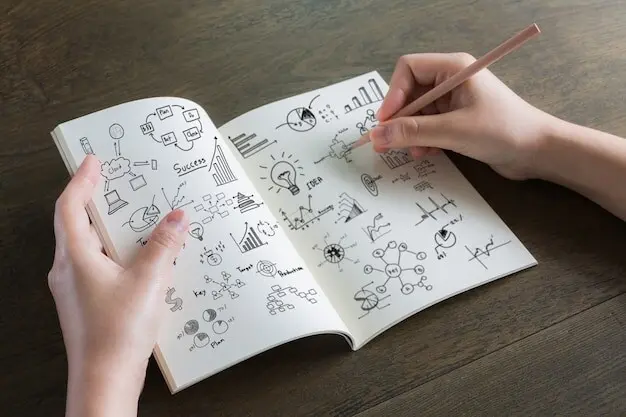
Pairing a keyword with a small icon creates two routes for retrieval, verbal and visual, so the idea is easier to find later. A lightbulb for insight, a clock for deadline, a box for task—tiny cues that dramatically speed scanning when time is short.

Offloading Working Memory

Sketching elements onto the page relieves your brain from juggling every detail, leaving precious capacity for reasoning. Boxes hold lists, arrows show cause, and clusters reveal groups. By externalizing thinking, you reduce overload, notice relationships sooner, and choose next actions with steadier confidence.

A Quick Story from a Meeting

During a product review, our team argued past one another for twenty minutes. I drew a simple swimlane with user steps, system steps, and pain points. Within minutes patterns emerged, priorities aligned, and we left with three bold, agreed actions captured clearly on one page.

Frameworks You Can Draw in Seconds

Certain structures turn chaos into options quickly. Mind maps fan ideas outward, 2×2 grids force tradeoffs visible, and timelines expose sequence and dependencies. Commit to drawing one framework per note, even roughly, and you will reveal gaps, risks, and opportunities faster than extended prose.

Mind Maps That Grow Naturally

Start at the center with a clear anchor word, branch big ideas clockwise, then add thinner branches for details. Use icons at branch roots to speed recognition. Keep lines curved, vary weight slightly, and stop when the map explains itself without extra narration.

Clarity with 2x2 and Priority Grids

Draw two perpendicular axes, label what matters—impact and effort are classics—and place options quickly without overthinking. Seeing clusters reframes debate and exposes outliers worth attention. Use arrows to show movement over time, and circle candidates for now, next, and later decisions.

Design for Readability Under Pressure

When you are capturing ideas live, legibility beats decoration. Establish consistent headings, spacing, and simple shapes so your future self can scan instantly. Gestalt principles help: proximity groups meaning, alignment reduces noise, contrast guides the eye. Aim for clarity first, style second, speed always.

Tools That Remove Friction

The best setup is the one you reach for without hesitation. Some swear by dotted A5 notebooks and brush pens; others thrive on tablets with pressure-sensitive styluses. Build a kit that fits your context, then streamline capture, storage, and sharing so habits survive busy weeks.

Analog Kits That Travel Well

A compact notebook, fineliner, gray marker for shadows, and two color accents cover almost everything. Add washi tape tabs as quick dividers. Choose paper that loves your ink and dries fast. Portability beats perfection because reaching for the kit repeatedly builds real fluency.

Tablets and Apps for Fast Iteration

Look for infinite canvas, shape recognition, and easy lasso moves to rearrange ideas. GoodNotes, Notability, OneNote, and Concepts shine in different ways. Create templates for grids and legends. Back up automatically. A matte screen protector can tame glare and improve pen control.

Hybrid Capture, Scan, and Tag

Work analog for focus, then scan with a flat perspective and auto-enhance. Title pages consistently, add tags like project, date, and decision, and sync to a searchable vault. Sharing annotated PDFs invites feedback while preserving your hand-drawn warmth and context-rich structure.

From Capture to Insight: A Simple Workflow

Great pages follow a rhythm: listen, capture, distill, connect, review. During intake, grab nouns, verbs, and numbers. Soon after, rewrite headlines, list decisions, and link related pages. Build a weekly review to spot patterns and pull next actions into your planner with confidence.

During the Moment: Capture Without Judging

Write big, use bullets, and sketch minimal icons beside each idea. Do not chase pretty. Mark questions with a bold question mark and park tangents in a margin box. Your only goal is completeness and flow, trusting clarity to arrive during later refinement.

After the Moment: Distill and Connect

Underline the spine sentences, add a summary banner, and rewrite any messy sections. Draw arrows to link related notes or create a tiny index. If something still feels fuzzy, sketch a small diagram to test understanding before committing tasks to your trusted system.

Review Cadence and Retrieval Cues

Schedule quick daily flips and a deeper weekly pass. Use consistent corner tags, page numbers, and symbols that act like beacons when scanning. Add a one-line outcome at the top of each page so future you can decide relevance instantly and move decisively.

Practice Routines That Stick

Skill grows through tiny, repeatable wins. Set constraints, like one page per idea or a five-color limit, and track progress with dated spreads. Join a community challenge, share experiments, and invite critique. Consistency turns hesitant lines into a confident visual language you trust.
Davolumaloro
Privacy Overview

This website uses cookies so that we can provide you with the best user experience possible. Cookie information is stored in your browser and performs functions such as recognising you when you return to our website and helping our team to understand which sections of the website you find most interesting and useful.